Quick Answer: Best Programming Languages to Learn in 2026
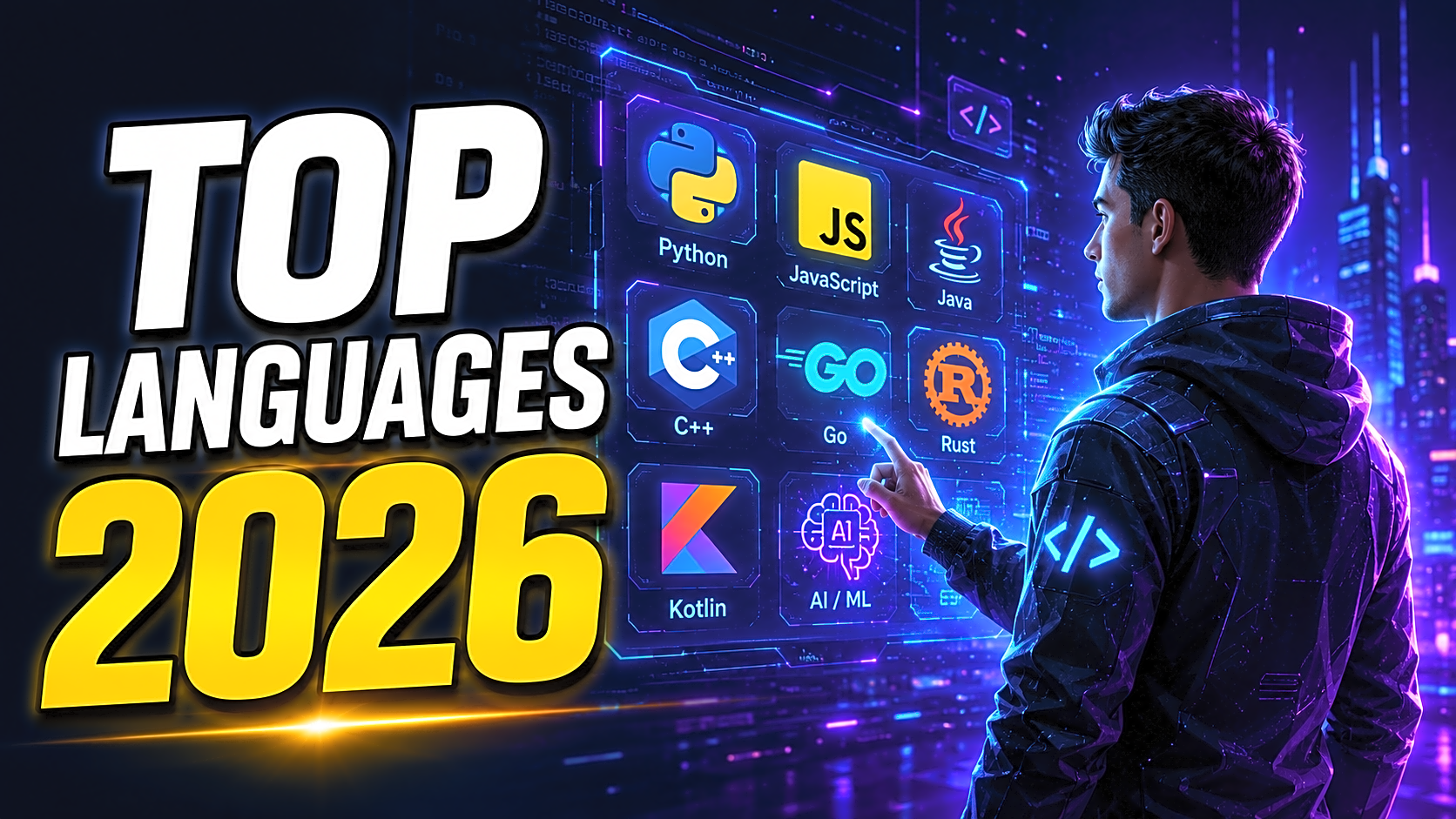
The best programming languages to learn in 2026 are Python, JavaScript, TypeScript, Java, SQL, C++, PHP, Go, Kotlin, and Rust.
For most students, Python is the safest first choice because it is beginner-friendly and useful for AI, machine learning, automation, data analysis, and web apps. JavaScript and TypeScript are best for web development. Java is strong for placement preparation and enterprise backend projects. SQL is essential because almost every serious project needs a database.
How We Ranked These Programming Languages
This list is not based only on popularity. A language may be popular but still unsuitable for your deadline or project type.
We ranked each language using five student-focused factors:
|
Ranking Factor |
Why It Matters |
|
Beginner difficulty |
Can students learn it within a realistic timeline? |
|
Final-year project fit |
Can it support login, database, admin panel, reports, and demo? |
|
Career value |
Is it useful for internships, jobs, or placements? |
|
Framework ecosystem |
Does it have strong libraries and tools? |
|
Viva/documentation ease |
Can students explain the project clearly? |
Industry trend reports such as TIOBE, GitHub Octoverse, Stack Overflow Developer Survey, and W3Techs also show why Python, JavaScript, TypeScript, Java, SQL, Rust, and Go remain important in 2026. However, students should treat these as signals, not as a fixed rule. The best language depends on your goal.
Best Programming Languages to Learn in 2026
1. Python
Python is the best first programming language for most students in 2026. It has simple syntax, strong libraries, and wide use in AI, machine learning, automation, data science, Flask, and Django projects.
Best for:
- AI and machine learning projects
- Data science projects
- Automation tools
- Flask and Django web apps
- Prediction systems
- Chatbots
Example final-year projects:
- Student performance prediction system
- Credit card fraud detection
- Complaint classification system
- Hospital management system using Flask
- AI chatbot for college enquiry
Students who want practical and fast project development can explore Python projects with source code to understand how Python is used in real academic applications.
2. JavaScript
JavaScript is essential for web development because it runs in the browser and powers interactive websites. If your project includes dashboards, forms, charts, admin panels, live validation, or frontend interaction, JavaScript is necessary.
Best for:
- Frontend development
- Full-stack web projects
- React apps
- Node.js backend
- Dashboards and admin panels
Example projects:
- Online examination system
- E-commerce website
- Job portal
- Expense tracker
- College event management system
JavaScript is a strong choice if you want a modern UI and live demo. For backend-focused students, Node.js source code projects can help you understand how JavaScript works beyond the browser.
3. TypeScript
TypeScript is JavaScript with type safety. It helps reduce errors in large projects and is becoming a preferred choice in modern frontend and full-stack development.
Best for:
- React and Next.js apps
- SaaS dashboards
- Enterprise frontend
- Team-based projects
- Maintainable full-stack systems
TypeScript is not mandatory for your first project, but it is a strong upgrade after JavaScript. If your goal is internship preparation or a polished GitHub portfolio, TypeScript gives your project a more professional structure.
4. Java
Java remains one of the strongest programming languages for students because it builds object-oriented programming concepts clearly. It is also useful for DSA, placement preparation, Spring Boot backend projects, banking systems, ERP systems, and enterprise applications.
Best for:
- Placement preparation
- OOP concepts
- Backend APIs
- Spring Boot projects
- Enterprise applications
Example projects:
- Library management system
- Banking management system
- College ERP
- Online quiz system
- Task management system
Choose Java if you want a balance between coding-round preparation and structured academic project development.
5. SQL
SQL is not optional for most serious student projects. Whether your project uses Python, PHP, Java, Node.js, or C#, you will usually need a database.
SQL helps with:
- Login and registration
- Student records
- Order history
- Attendance reports
- Complaint tracking
- Admin dashboards
- Search and filters
Every student should learn basic SQL queries, joins, aggregate functions, primary keys, foreign keys, and normalization. SQL also helps during viva because database design is often discussed by faculty.
6. C++
C++ is excellent for DSA, competitive programming, system-level understanding, and performance-heavy logic. It is not the easiest choice for a web-based academic project, but it is valuable for placement coding rounds.
Best for:
- DSA preparation
- Competitive programming
- System-level concepts
- Performance-based applications
A practical approach is to learn C++ for DSA and use Python, Java, or JavaScript for your final-year project.
7. PHP
PHP is still practical for academic web projects because it connects easily with MySQL, supports CRUD operations well, and is simple to host. Many college-level projects are still built using PHP and MySQL.
Best for:
- College management systems
- Library systems
- Booking systems
- Food ordering systems
- Admin panel projects
PHP is a good choice when you need a quick, database-driven project with login, admin panel, and reports. You can check PHP final-year project source code if your priority is fast implementation with MySQL.
8. Go
Go is useful for students interested in backend development, APIs, cloud systems, DevOps tools, and microservices. It is simpler than many system-level languages and works well for scalable backend services.
Best for:
- Backend APIs
- Cloud tools
- Microservices
- DevOps utilities
- High-performance services
Go is better as a second or third language after you understand basic programming and web development.
9. Kotlin
Kotlin is a strong choice for Android development. Students who want to build mobile app projects should consider Kotlin instead of older Java-based Android approaches.
Best for:
- Android apps
- Student utility apps
- Firebase-based apps
- Attendance apps
- Study planner apps
Kotlin is useful if your project idea is mobile-first and you want to target Android app development.
10. Rust
Rust is powerful for systems programming, memory safety, security-focused tools, and performance-critical applications. It is highly respected among developers, but it has a steeper learning curve.
Best for:
- Advanced learners
- Systems programming
- Security tools
- Blockchain experiments
- Performance-critical software
Rust is not the best first language for quick academic CRUD projects, but it is excellent for students who already have strong fundamentals.
Programming Language Comparison Table
|
Language |
Best For |
Difficulty |
Project Fit |
Career Value |
|
Python |
AI, ML, automation, web |
Easy |
Excellent |
Very High |
|
JavaScript |
Frontend, full stack |
Easy-Medium |
Excellent |
Very High |
|
TypeScript |
Modern web apps |
Medium |
Very Good |
High |
|
Java |
Backend, OOP, DSA |
Medium |
Excellent |
Very High |
|
SQL |
Database and reports |
Easy |
Essential |
Very High |
|
C++ |
DSA and performance |
Medium-Hard |
Medium |
High |
|
PHP |
CRUD web projects |
Easy |
Very Good |
Medium |
|
Go |
APIs and cloud backend |
Medium |
Good |
High |
|
Kotlin |
Android apps |
Medium |
Good |
High |
|
Rust |
Systems and security |
Hard |
Advanced |
High |
Best Language by Student Goal
|
Student Goal |
Best Language |
Why |
|
AI/ML project |
Python |
Best libraries and simple syntax |
|
Web development |
JavaScript + TypeScript |
Strong frontend and full-stack value |
|
Placement/DSA |
Java or C++ |
Good for coding rounds and OOP |
|
Quick academic project |
PHP + MySQL or Python Flask |
Fast CRUD development |
|
Android app |
Kotlin |
Modern Android development |
|
Backend/API career |
Java, Node.js, Go |
Strong backend ecosystem |
|
Database-heavy project |
SQL with any backend |
Essential for reports and admin panels |
Best Tech Stack Combinations for Projects
|
Project Type |
Recommended Stack |
|
AI/ML web app |
Python + Flask + SQLite/MySQL |
|
Full-stack web app |
MongoDB + Express + React + Node.js |
|
Enterprise backend |
Java + Spring Boot + MySQL |
|
Quick academic CRUD project |
PHP + MySQL |
|
Android app |
Kotlin + Firebase |
|
Modern dashboard |
TypeScript + React/Next.js + PostgreSQL |
|
Machine learning project |
Python + Pandas + Scikit-learn + Flask |
Students who need ready project references can explore final-year project ideas or machine learning projects before choosing a language.
30-Day Learning Roadmap for Students
|
Week |
What to Learn |
Output |
|
Week 1 |
Syntax, variables, loops, functions, basic OOP |
Small practice programs |
|
Week 2 |
Mini project with forms, files, or basic UI |
Working prototype |
|
Week 3 |
Database/API integration |
Login, CRUD, search, reports |
|
Week 4 |
GitHub, testing, deployment, viva notes |
Portfolio-ready project |
Do not try to learn five languages at once. Choose one main language, build one working project, and explain it properly.
Common Mistakes Students Make
Choosing a language only because it is trending
A trending language is not always right for your project deadline, college requirement, or current skill level.
Ignoring SQL
Many students learn frontend but struggle to explain tables, joins, foreign keys, and database flow during viva.
Copying without understanding modules
If you cannot explain login, CRUD, authentication, dashboard, and database connectivity, your project becomes weak.
Learning too many languages at once
It is better to build one complete project than to collect certificates in many languages without implementation.
Choosing the wrong language for the goal
Do not choose PHP for AI/ML, Rust for a quick admin panel, or C++ for a web dashboard unless there is a specific reason.
Pro Tips for Final-Year Students
- Learn one main language deeply.
- Pair the language with a framework.
- Add SQL to your roadmap.
- Choose projects with admin and user modules.
- Add ER diagram, DFD, UML, test cases, screenshots, and setup steps.
- Upload your project to GitHub with a proper README.
- Record a demo video or deploy the project.
- Prepare viva answers around the project workflow, not just the language.
For stronger presentation, students should also learn how to publish their project on GitHub and use ready-to-run final-year project source code only after understanding the modules.
FAQ
Which programming language should I learn first in 2026?
Python is the best first language for most beginners because it is readable, flexible, and useful for AI, automation, web development, and academic projects.
Is Java still worth learning in 2026?
Yes. Java is still useful for enterprise applications, backend development, object-oriented programming, DSA, and placement preparation.
Python or JavaScript: which is better for students?
Python is better for AI, ML, automation, and data projects. JavaScript is better for frontend, full-stack web apps, dashboards, and interactive websites.
Python or Java: which is better for final-year projects?
Python is easier for quick prototypes and AI projects. Java is better for enterprise-style backend projects and OOP-focused academic submissions.
Which language is best for placement in India?
Java, C++, Python, SQL, and JavaScript are strong options. Java and C++ are useful for DSA rounds, while Python and JavaScript are useful for practical projects.
Is SQL necessary for programming students?
Yes. SQL is essential because most projects need login, records, reports, search, filters, admin panels, and database management.
How long does it take to learn Python or JavaScript?
A beginner can learn basic Python or JavaScript in 3–4 weeks if they practice daily and build a mini project. Becoming job-ready takes longer and requires real projects.
Which programming language is best for AI projects?
Python is the best language for AI and machine learning projects because it has strong libraries such as NumPy, Pandas, Scikit-learn, TensorFlow, and PyTorch.
Conclusion
The best programming language to learn in 2026 depends on your goal. For most students, Python is the safest starting point. JavaScript and TypeScript are best for web development. Java is strong for enterprise projects and placement preparation. SQL is essential for almost every serious project. C++ helps with DSA, while Kotlin, Go, and Rust are useful for specialized career paths.
The smartest approach is simple: choose one language, connect it to one project idea, build a working module, add database integration, upload it to GitHub, and prepare a clear viva explanation.
That is what turns a programming language into a real project, a stronger resume, and a better career opportunity.